Wednesday, January 18, 2017

Professor Long Vudthy - Our Extraordinary Guide

Professor Vudthy explaining Cambodian history as we sat on the wall of a small ruin in Angkor Thom. 
Our Cambodia guide is an extraordinary man. Professor Long Vudthy has lived a life full of challenges and accomplishments. He was born in 1961 in Battambang Province, moving with his family in 1964 to Phnom Penh so his father could work as an advisor to the government. His world was shaken when the brutal Khmer Rouge took power in 1975, a terrible time made even more dangerous because of his family's government connections. Vudthy survived years of torture and forced labor. His body is scarred, but his spirit is unbreakable.

Vudthy showing us a photo of a spider crawling across his face. He is clearly not afraid of spiders.
The arrival of the Vietnamese army in 1979 marked the beginning of the end for the Khmer Rouge, but not the end of the struggles for Vudthy's family. Following their father's instructions they fled to a refugee camp on the Thailand border where they stayed for much of the civil war. They often had to forage in the jungle for food, while avoiding soldiers from all sides, and navigating through the mine fields that were everywhere. A young man now, Vudthy became a Buddhist monk for four years, where he studied the history of the Khmer people, and learned a variety of languuages including English, Spanish, and Thai (eventually adding conversational German, French, and Japanese - he is also able to read and translate all the ancient Khmer scripts, Sanskrit and Pali - an ancient Prakrit language used in early Buddhist literature).

Vudthy showing us one of his many certificates documenting his education and accomplishments.
Vudthy and his family remained in the refugee camp until 1993. During these years Vudthy began working as a medic (his father was a traditional healer) and teaching English to the children living in the camps. In 1987, Vudthy was hired by Harvard University to help in their mental health program for the refugees. He continued to work as a medic including assisting in surgeries on war casualties. With the civil war finally coming to an end, Vudthy and his family were able to leave the camps. Both Vudthy and his one surviving brother took jobs working with United Nations in rebuilding their country. Vudthy went back to Phnom Penh where he assited in the UN HIV/AIDS education program (work he started in 1992 while still living in the refugee camps). He also started guiding some of the visiting dignitaries, using his knowledge of Khmer history that he learned as a monk.

In 1995 he was hired by the UN as a Participatory Action Research Specialist (a branch of applied anthropology). Vudthy was sent to Siem Reap where he conducted socioeconomic research in the rural communities within Angkor Park. The goal of this research was "livelihood improvement" for the residents of the park, especially among those who suffered the most because of the restrictions from historic preservation rules. He helped develop training programs for park workers and guides. As a result of these programs, Vudthy returned to teaching at the universities in Siem Reap where he is now a Professor of Anthropology, Archaeology, and Culture & Civilization.


Vudthy showing us the villages in Angkor park that were a part of his Participatory Action Research.
I'm not sure how many people Vudthy has personally helped heal or taught over the years, but we meet these people everywhere we go. While eating lunch in Banteay Chhmar a student of Vudthy's from 34 years ago recognizes Vudthy's laugh and comes over to great us and his old teacher. Driving through the countryside we stopped to take a photograph of some fishermen one of whom it turns out was Vudthy's colleague from his time as a medic. Our tuk-tuk driver was Vudthy's student as we're many of the monks we saw at the pagoda we visited. We feel more than just a little fortunate that we get to travel around Cambodia with Vudthy and being a part of his world.
Vudthy and former student, Samut Vichea, in Banteay Chhmar.
A last note, this brief biographical sketch is only a part of the story. Vudthy is also a master gemologist and an accomplished musician (and music teacher) able to play the guitar, piano, drums and several other instruments. He's the father of seven children with an additional 47 foster and adopted children sharing his home. Although we've not yet seen him eat fire, he has told us he's a bit of a wizard and we don't doubt him when he claims he can.

Vudthy wowing us with some Cambodian gemstones.

Wednesday, January 11, 2017

Opportunity Abroad

One of the main purposes of this trip is the aspect of tourism in and around the area, from their interaction with the ruins and their surroundings to how the locals receive them. Today, I found tourists using the ruins in a unique way.
During our visit to East Mebon temple, I did what I have done at every temple and wandered around trying to find every small space and corridor I could, exploring every corner of the ruins. While climbing around, I stumbled across a woman it what appeared to be a wedding dress. Since I had only seen her from a distance I was eager to get a closer look and find out exactly what was going on. keeping enough distance that I was not in her way, I found my way around the stones until I was a few feet away. Her and a man were attempting to take photos in a doorway on the far side of the temple. Of course, I was a disturbance as I was the only other person on that side. I assumed they were wedding photos or something of that sort so I headed back to the stairs I came from, running into Brian who was looking at the same display. After voicing a few questions about them to him, he insisted I ask the two of them.
East Mebon Temple

Reluctantly, I went up to them and hoped they spoke english. Luckily they did, as were happy to talk to me (what a relief). Their story was much more interesting than I anticipated. I learned they were a couple from Brazil on their honeymoon, traveling through Myanmar, Cambodia, and Thailand. She decided she wanted to bring the wedding dress with in case she had any photo opportunities. As she put it, "Why not? I'm only wearing it once anyway, might as well get some use out of it". She wore the dress during a balloon ride and brought it with to every temple they had visited in Cambodia. Unfortunately, this was their first chance to get any ruins photos since most of the temples are flooded with tourists walking in and out of every picture one takes. They tried in Angkor Thom and Ta Prohm with no luck. They found the secluded spot of East Mebon, threw on the dress, and began the shoot. Until I came along, that is.
A sneaky shot

This was a new form of tourism and tourist opportunities that I was fortunate to witness and probably will not see again. People are always finding ways to use things like they have not been used before, such as using the ruins for a specific type of picture (like a senior photo or wedding photo), taking the tourist experience to a different level than most of those that visit. Even we take part in this, using the attraction of sites as a sort of magnet for those we want to study. People's ability to manipulate situations and places to serve a means and their creativity in doing so always keeps me on my toes.

Tuesday, January 3, 2017

Our Departure Date Draws Near

As each day passes my excitement and anticipation grows. Every reading that I complete gives me a little more insight into what we will be seeing once we arrive at Siem Reap and Angkor Wat. The history of Cambodia is complex and, like much of Southeast Asia, complicated by colonization, war, and communism. Our visit will include ancient temples built in 9th century as well as the Khmer Rouge Killing Fields and, as I look over the itinerary, I imagine the glimpse into Cambodia that each day will give us. As the students explore what tourism means to a country that has struggled economically, I'm curious to learn not only from our guides, but from the students as well.
One thing is sure, I can't wait to see what this trip has in store for us.

Sunday, January 1, 2017

The Monastery of the King

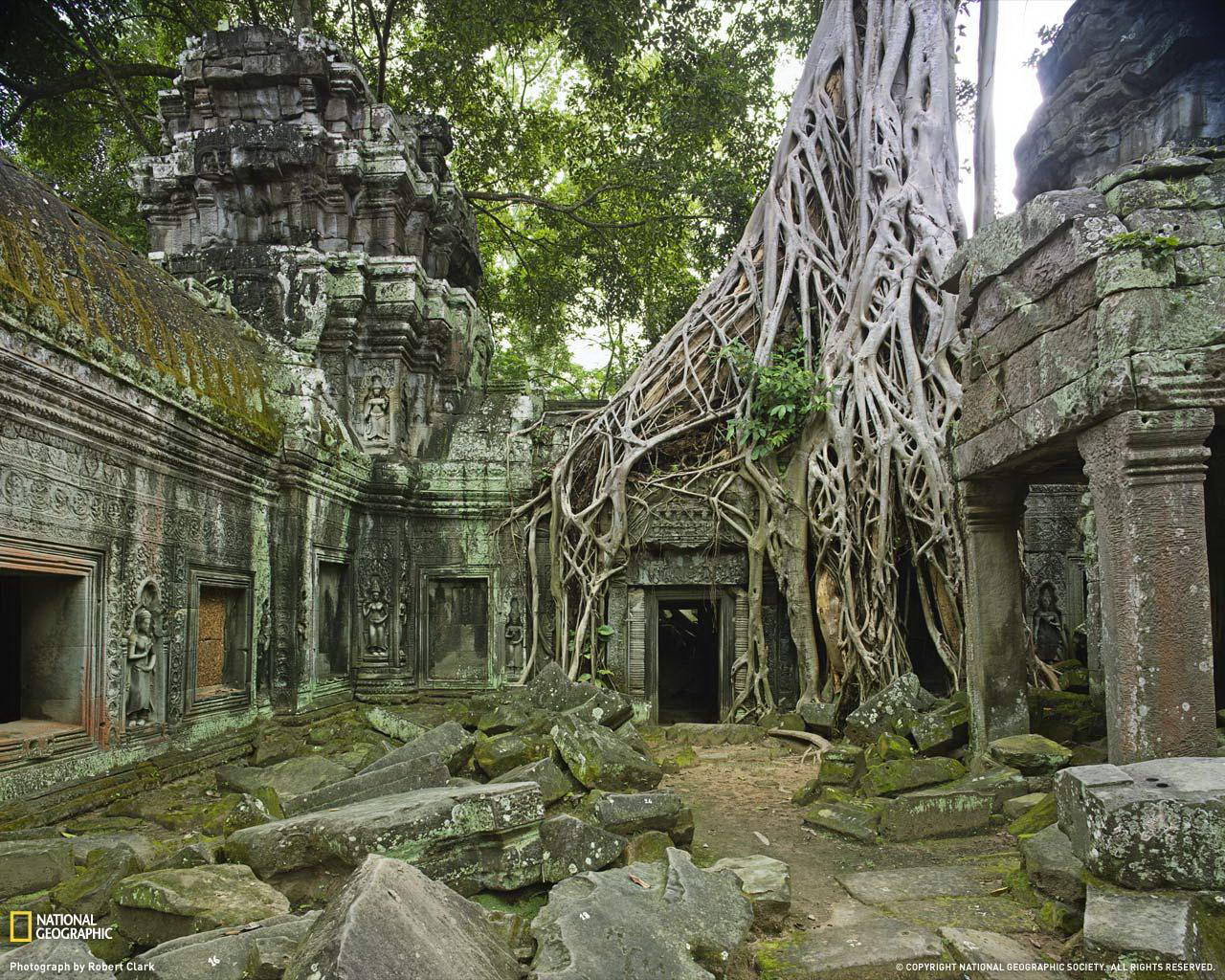
A couple of years ago, I took a great interest in the Ta Prohm temple after seeing pictures of trees and plants twisting and encasing the walls and artwork within and around the temple. After a fair amount of research, I found that the history of the temple is almost opulent in its nature, contradicting the current shape of Ta Prohm.

                              http://www.meros.org/en/wonder/view?id=371

Ta Prohm was built in the 12th Century, formerly known as Rajavihara, or "Monastery of the King." I was a center of culture and commerce, home to thousands of people as well as a considerable amount of gold and silks. It was also a center of religion, home to stone carvings and artwork depicting Buddhist tales and monks. However, it was abandoned in the 15th Century and proceeded to be neglected for centuries before restoration began again only a few years ago. as a result, the shining, glittering hub it used to be is now being taken back by the jungles around it. 

                               www.matthewlees.com

I am excited to have the opportunity to visit a temple I have always longed to visit, remembering its past and witnessing its present, imagining what it must have been like in its heyday so long ago when before it was left to the jungle.